Updated October 12, 2026
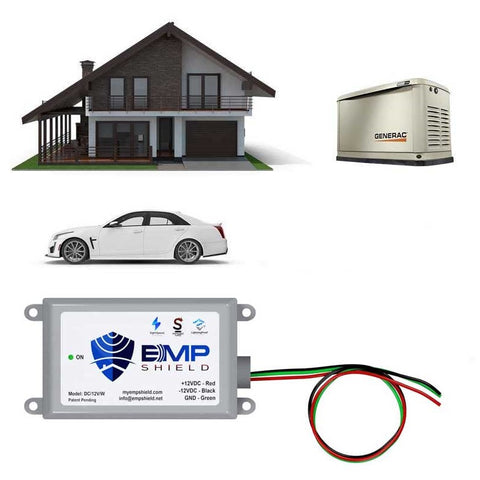
An EMP Shield is a connected electrical-protection device sold for specific home, vehicle, generator and communication-system applications. It is intended to limit certain fast electrical transients on the conductors to which it is correctly installed. It is not a Faraday cage, backup power source or guarantee that every electronic device will survive every electromagnetic event.
Does EMP Shield provide EMP protection?
EMP Shield publishes third-party test documentation for specified models and configurations. The Keystone Compliance report records pulsed-current injection and RS105 radiated-susceptibility testing. That evidence supports discussing the tested device’s response under those conditions; it does not prove that an entire house, vehicle or every connected electronic component is “EMP-proof.”
Does EMP Shield provide lightning protection?
EMP Shield products are also marketed for lightning-related surge protection. Lightning, switching surges and nuclear EMP are different events, even though a protection device may be designed to divert transient energy from more than one source. A direct strike can use unexpected paths through power, data, antennas, plumbing or structural systems, so one device should be treated as part of a broader lightning- and surge-protection plan.

What can a connected protection device cover?
-
Home model: connects at a supported electrical panel and addresses transients on the associated power conductors.
-
Vehicle model: connects to a supported DC electrical system; it does not enclose every control module, antenna or sensor path.
-
Generator model: is selected for supported generator configurations and must be coordinated with the installation.
-
Radio and data models: are designed for particular antenna, coaxial, Ethernet or fiber arrangements; connector and power ratings matter.
What it does not do
- It does not keep the utility grid operating.
- It does not supply electricity during an outage.
- It does not automatically protect wiring paths to which it is not connected.
- It does not replace grounding, bonding, code compliance or a coordinated surge-protection system.
- It does not turn a room, house or vehicle into a tested Faraday enclosure.
How to choose the correct model
- Identify the system: home service, vehicle, generator, radio or data line.
- Confirm voltage, phase, grounding arrangement, connector type and power rating.
- Read the report for the exact model instead of relying on a generic badge.
- Map every important incoming conductor and decide whether it needs separate protection.
- Use a qualified installer whenever the product or electrical code requires one.
Bottom line
EMP Shield can be a documented layer of protection when the correct model is properly installed on the system it was designed to protect. The defensible claim is narrower than “complete protection”: it addresses specified conducted or radiated test conditions and must be combined with safe electrical work, protected portable spares and an outage plan.
Browse the active EMP Shield home, vehicle and generator bundle, or read our test-evidence review.
Sources
Match protection to the application
Compare vehicle EMP protection for the intended electrical installation, or Faraday bags for appropriately disconnected stored electronics. These are different protection methods; a military test-method reference is not a military endorsement or a guarantee for an entire system.


Leave a comment